


Understanding the Role of a Deer Stalker


Understanding the Role of a Deer Stalker
Author: Lewis Macfarlane Editor: Al Louangketh
While many parts of Europe and the world are in “lock down” due to the Coronavirus outbreak, many UK Deer Manager, Land Manager and Recreational Deer Stalker are looking out of their windows hoping to soon break free of our Government quarantine and get out into the forestry and farm land, especially with the start of the Roe Buck season on the first of April over a month ago. Currently the situation in the UK will only allow certain land managers and the hunters to go out if damages to farm land are very critical and deemed essential.
So while we are all cleaning our Bergara rifles, preparing our equipment and day dreaming of being out and about on our favourite stalking grounds in the fresh air with that early morning chilly breeze in our face, lets dwell a bit into The European Roe (Capreolus capreolus) A common deer species in the UK that can destroy new growth in the forest and wreak havoc if proper management is not put in place to help control the population to where it balance out in favour of the management plans.
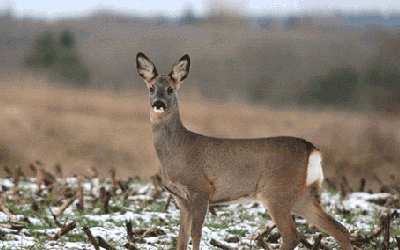
Quick Description – Small deer, approx. up to 1m tall, chestnut colour in Summer and grey with a tint of chestnut brown in some deer during the Winter. Weight – Adults can vary between 11kg and 25kg. The Habitat you’ll find UK Roe are in Urban Areas, Mountains and low valleys, Coniferous Woodland, Deciduous Woodland, Mixed Woodland and Farmland (most types).
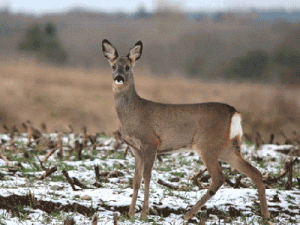
In late winter you can sometime see groups of Roe out in the fields, but it’s not uncommon to see one by itself also.
The European Roe, or simply “Roe”, is one of the most widely spread deer species in Europe. They range from the Mediterranean to Scandinavia and as far as the Korean Peninsula. These “little” deer are very hardy animals and their aggression during the rut in mid-July to early August can be fatal to when they fight for dominance. I’ve seen Bucks fight to almost death and seen the victorious Buck push wounded Bucks away – some with only small wounds and others not so lucky.
Most descriptions of Roe are that they are crepuscular in nature, however, as most deer managers and stalkers can attest to, this isn’t always the case. Many times, we’ve seen Roe moving through forests and grasslands during most parts of the day and it isn’t season dependant. That said the old “folk lore” is that Roe know the open/closed seasons better than most stalkers.
Their habitat and diet varies, however, their staple diet is young grass shoots, new leaves and new pine growth and various berries. Those that have ever walked through a new plantation of forestry will have noticed that young trees have had their tops nipped off. Rarely do they intermingle with farm livestock species, such as sheep, but when conditions are harsh, they will take various feeds left out for livestock and during stages of pregnancy they can be seen utilising livestock salt and mineral licks to replenish and bolster their needs.
The maximum life span of a Roe deer on average is about 10 years. This will obviously varies depending on location and habitat as well as availability of food source and predators.
So the basic understanding of the Roe deer is out of the way, let’s talk about the equipment that most stalkers use in the UK.
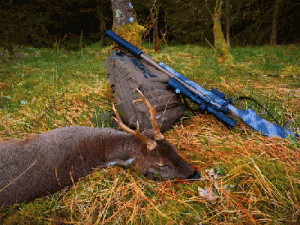
A 3-year-old Roe Buck taken with a Bergara Premier Approach in .308 Winchester using a Hornady ELD-X 178gr bullet. Quick and humane dispatch of any game is of utmost importance.
We always get asked, “What’s the best” for this and that related to deer stalking, but there is no “best”. It’s simply what does the job, does it well and what you, the Stalker can afford. There are certain rules and laws we have to adhere to, some of them are a bit strange, especially for foreigners, but we all can agree that they are there for safety reasons and for the humane dispatching of deer.
My preferred tool for this type of shooting (Stalking) is the Bergara HMR in either 6.5 Creedmoor or 300win, Tract Toric 4-20 UHD scope and a Stalon Sound Moderator. As for ammunition, I always go with the 143gr ELDX in 6.5 and the 200gr Barnes LRX in the 300win. Keep in mind, my prefer choices are favoured in my rifles and my intent. Some of my hunters under my management lease use various cartridges in their rifles such as the .243win, 6mmBR and the 6mmXC. In deciding on what cartridge we chose to hunt with, we use what we are comfortable in shooting with, whether it be a mild recoil .243 Winchester or the thumping .300 Win mag, all have to fire the right loads to do the job and dispatched the games as quickly and humanely as possible.
Being a stalker, it’s imperative that you understand your rifle, loads and equipment, as well as the game you’re pursuing and the habitat you are hunting them in, and it all comes down to practicing with that equipment you’ll be using to ensure you only take the necessary shot you need to take, in order to dispatch that game in a quick and safe manner at various distances.
Most deer are taken by stalkers in the UK under 200 yards, which is a good thing in my opinion. Short distance doesn’t allow shooters to overstretch their capabilities or be overconfident in thinking they can make longer shots, just because a rifle can do it, it doesn’t necessarily mean every shooter can. So anything up to 200 yards are a good thing and it also helps to mitigate bad shot placement on such a small target out at longer distances.
Unfortunately though, some situations won’t give you that perfect shooting scenario, so sometimes 200 yards or less isn’t always viable, especially when we have to cull certain amount of games in a certain amount of time and the environment or terrain dictates these scenarios for you and you still have to get the job done. Under these conditions, understanding and practicing with your rifle and equipment is one of the key elements in ensuring you can get it done safely and humanely at various distances by knowing your capabilities as well as the equipment you’re using as a stalker.
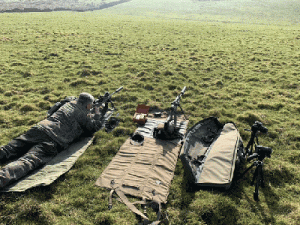
Practice shooting at various distances to understand the rifle, ammo and the equipment you’ll be using for any hunt is a key part of being a stalker.
One such situation of longer shots is a contract undertaken by myself and my team at North West Deer Services (NWDS) toward the end of 2019. The contract called for a Doe cull, the ground was a flat mixture of clear-cut forest with new plant/regrowth and grassland. The majority of Does taken were in the middle of the grassland and getting any closer wasn’t feasible due to the wide open field and the only approach was from the clear-cut forest that provided some kind of concealment for us to get to about 300 yards to the closes Doe. During this culling management scheme, most of our shots were taken between 300 and 500 yards, this is why it is imperative to practice as much as you can.
All of the stalkers at NWDS are extremely proficient not only their stalking skill, but have long range experiences and done extensive long range practice shot placements to where it became a comfortable norm for them. Tools for the job were a mix of calibres, optics, and various brand cartridges, but they all had a few things in common, long range scopes, heavy barrel rifles, sound moderators, rifles that were meant for such long distance shooting, thus providing a steady platform to be able to humanely take a Roe deer with pinpoint accuracy out at those distances to get the job done.
Some key elements of success I would like my stalkers (hunters) to know and understand.
- Know your equipment and limitations; practice shooting at various distances and positions.
- Practice with the same equipment; rifles, loads, and optics you’ll be using.
- Don’t rush yourself to failure; know and understand the environment and terrain.
- Knowledge and understanding of deer biology, characteristic, behaviour and forestry.
- People skills; interacting with general public, mitigate issues or solve on-site problems.
- General knowledge of first-aid, qualification with certain trainings to assist with injuries.
- Know and understand firearm legislations, rules and regulations.
- Understand game management plans and adhere to forestry rules and guidelines.
- Know your equipment and know how to employ them to be successful.
Other equipment that is a necessity to a stalker are good clothing for the situation and time of year, footwear, a game bag, quad or other various form of shooting sticks and the obvious binoculars.
Many UK stalker use Zeiss, Swarovski and Leica, but those come at a premium cost. I have a stalker on my team that use a pair of Bushnell Binoculars and it has worked for him. It’s not always about owning a pair of overly expensive Binoculars or other equipment but, what you can afford and above know and understand how to use it and employ it to your advantage.
I personally I use 2 types of binoculars, and it really depends on what and where I’m stalking. If it’s England a pair of Delta Forrest 2’s does the job perfectly, not the best in low light but does the job. If I’m in Scotland, where the forest is thick and dark, I will go with the Tract Toric 10×50 Schott HT Binoculars.
With all that is said above, when we take paying clients out stalking, we will do the exact opposite for their stalking equipment and keep it simple and basic due to various levels of skill and understanding these clients have when we accompany them out to hunt. The Rifle they will be using will generally be one of 3 calibre choices, .243win, 308win and the 7mm Rem Mag. The scope is a fixed magnification scope, a Schmidt and Bender Classic in the 8×50 range, or if magnification is required for open areas we will use either the Night Force NXS 3-15×50 or a Swarovski Z6i 2-12×50.
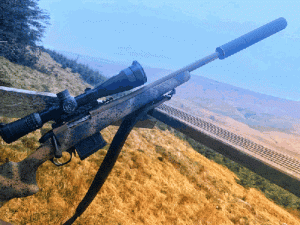
Having the right equipment and using it properly will improve your chance of success in every environment and conditions.
Good clothing and footwear is a must for any stalker. My personal preference is Deer Hunter and Harkila clothing brands. General day to day stalking I use Harkila trousers and jacket, but for long days on contract management work, I will put on my Deer Hunter Recon Jacket and trousers. Footwear should be one of the most important thing for any stalker. My prefer choice is a pair of Meindl Dovre Extreme boots – they just work, excellent design to keep the elements out, robust and extremely comfortable for those mile and miles of stalking in the North of England or Scotland.
As for day pack, rucksack or pack, you want something that will not only carry your gear, but also provide enough room to carry out your game to the nearest road or to your vehicle. This is an added extra and always something a stalker should have in the truck for a “just in case” day when you feel like hunting farther away from the vehicle. I personally use the “Schwarzwald” rucksack by Ammala Outdoors, it’s designed to carry your gear as well as provide enough room to carry out a Roe buck or Doe and I have to say it’s one of the most comfortable Roe rucksacks I’ve used.
The final items on the list are quad sticks or any form of shooting sticks that can provide you a steady enough platform to shoot from. I know stalkers that have made their own shooting sticks from green garden sticks or semi straight branches from a tree. Shooting sticks don’t need to be elaborate or expensive, as long as it provides you a comfortable and steady platform from whatever you can find and build, go with it if it works for you. There are a few European brands out there that are very good, some made from aluminium or carbon that you can adjust the height to meet the shooters need and they work, but the price range for one can be a bit high for something that might not be used as much as one would like, but if you find some that are cheaper or end up building one yourself and it works for your needs, than by all means, use it.
In closing, we have various courses from various institution aimed towards Deer Stalking for those interested in stalking games in the UK. The course gives the novice stalker something to start them on their journey and help them understand enough of their role as a hunter to be able to confidently go out there and be successful out in the fields. The main course for stalkers is attending the Deer Stalking Certificate Level 1 or better known as the DSC1 in the UK as 99% of forestry require a Firearm Certificate (FAC) and insurance to be able to hunt on private/leased forest.
This course (DSC1) takes the novice stalker from being able to identify sex and species all the way to understanding the legal requirements, regulations and firearm legislations, and in the end, a level of training, knowledge and education are not just beneficial for the stalker and forestry, but as whole, it makes us understand our role as deer stalkers a bit better.
About the Author
Lewis Macfarlane is the owner of North West Deer Service, a premier deer management organization based in the Northwest region of England and the border area of Scotland. He is also a contributing blogger and Administrator for the Bergara International Group on Facebook. He is a husband, father and former British Army Veteran living in the United Kingdom. [email protected]